
Bonded fabric delamination is the separation of the face cloth from its backing at the adhesive line. The industry standard way to measure resistance to it is a peel strength test — pulling the two layers apart at a defined angle, speed and specimen width, and reporting force per unit width. Common methods are ASTM D903 (180° peel), ISO 2411 (T-peel for coated fabrics), AATCC TM 136 and ASTM D2724 (bond strength of apparel laminates after laundering or dry cleaning). There is no universal pass/fail peel-strength value: buyers must specify the test method, the wash or dry-clean cycles, the minimum retained strength and the acceptable failure mode for their end use.
That single sentence is worth reading twice, because most delamination disputes at the inspection stage come from nobody agreeing on those four variables before the order was placed.
A bonded coat fabric that survives the sales sample and fails the bulk lot is one of the most expensive quality events in winter apparel. The fabric is already cut, the sewing lines are booked, and the failure shows up weeks later — bubbles across a chest panel, a backing that lifts at the hem, or a white line of exposed adhesive along a fold. Delamination is rare as an incoming defect. It is usually a durability defect: the bond looks fine on the roll and lets go after wash, press heat or flexing.
This guide covers how bonded fabric delamination is actually tested, what the numbers mean, why bonds fail, and exactly which reports to require before releasing a bulk order. It pairs with our bonded fabric inspection checklist, which places these tests at the right checkpoints in an order timeline; here we go deep on the bond line itself.
What Delamination Is — and What It Is Not
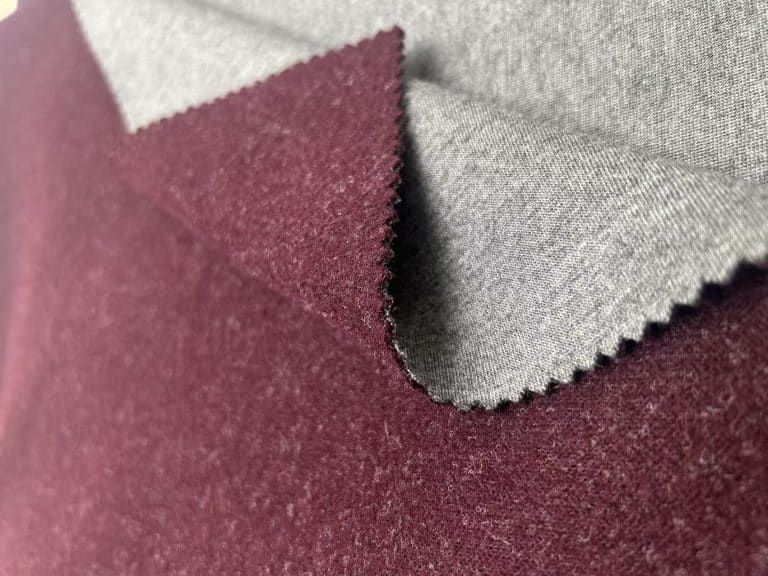
Wool-feel bonded fabric is a face cloth laminated to a backing (jersey or fleece) with a thin adhesive layer between them. Three things can go wrong at that interface:
- Delamination: the layers separate cleanly at the adhesive line. The classic sign is two plies you can peel apart like a sticker, often starting at a cut edge or an arc of fusing pressure.
- Bubbling: the bond survives overall but lifts in localized domes, usually visible against a light source and worst after pressing.
- Edge lift / cleaving: separation along selvedges or roll ends where adhesive coverage was thin.
None of these are the same as a low peel strength. A fabric can have a healthy bond number and still bubble if the adhesive is too stiff for the drape required, or if the backing shrinks differently from the face under heat. That is why test methods report the failure mode, not just the force.
If you are still deciding between backing types, our jersey vs fleece backing guide covers how each construction behaves under the press and in the wash.
The Four Test Methods That Matter
All four measure the same physical quantity — force per unit width needed to propagate a separation — but they differ in geometry, specimen prep and what they were written for.
| Method | What it is | Where it fits |
|---|---|---|
| ASTM D903 | General 180° peel test for adhesives bonded to flexible or rigid substrates. A 25.4 mm (1 in) wide strip is peeled at 180° at a constant crosshead speed (classically 152 mm/min); the result is the average force over the stable peel region, excluding the initial peak. | The workhorse number. Best for comparing lots against an agreed internal spec. |
| ISO 2411 | T-peel test for rubber- or plastic-coated fabrics (PU/PVC coatings, some laminate constructions). A 75 mm wide specimen is peeled in a T configuration at 100 mm/min; reports average, median, minimum and maximum force. | Useful when the bond layer behaves like a coating film rather than a spot lamination. |
| AATCC TM 136 | Bond strength of bonded/woven-fabric laminates for apparel, explicitly designed to be run after specified laundering and/or dry cleaning cycles. | The apparel-native method: it frames the question buyers actually have — does the bond survive care? |
| ASTM D2724 | Bond strength of bonded, fused and laminated apparel fabrics, evaluated after dry cleaning or laundering, including appearance change. | Common in US-market garment specs; often paired with AATCC wash procedures. |
A practical note on geometry: a 180° peel loads the bond like a lifted corner; a T-peel loads it like a seam opening. Results from the two are not interchangeable numbers — a spec that says “peel strength ≥ X” without naming the method and specimen width is unenforceable.
On internal spec codes. You may see buyer specs citing codes like “IL-170” or similar internal numbers. These are brand or lab-specific procedures, not published industry standards. Ask for the actual method text (angle, width, speed, conditioning) rather than accepting a code and a threshold.
Reading the Numbers: Units and Typical Ranges
Peel strength is force divided by specimen width:
peel strength = average peel force ÷ specimen widthCommon units: N/cm, N/50 mm, N/mm, lbf/in. Conversions: 1 N/mm = 10 N/cm = 1 kN/m, and 1 lbf/in ≈ 0.175 N/mm.
What ranges are normal for apparel-weight bonded fabric? From testing-laboratory and mill practice, commonly cited commercial specification bands are:
- Light apparel lamination / decorative bonding: roughly 1–2 N/cm
- Regular garment laminates (coating, trouser, jacket weights): roughly 2–5 N/cm
- High-flex, workwear or technical use: higher, plus retained-strength requirements after ageing
Two honest caveats. First, these are commercial reference ranges, not limits set by ASTM or AATCC — the standards define how to test, not what is acceptable. Second, the right number depends on face cloth, backing, adhesive chemistry and end use, so agree it per style with your supplier before bulk. Our fabric testing support page explains how we set test parameters with buyers at quotation stage rather than after the fact.
The Test That Actually Predicts Trouble: Wash Retention
A dry, as-laminated peel number tells you the bond is glued. The post-laundering retest tells you whether it survives a consumer. The standard design:
- Baseline: peel test on conditioned, untreated specimens.
- Care cycles: launder (AATCC-standardized washing procedures) or dry clean a defined number of cycles — 3, 5 or 10 are the common commercial checkpoints; garments expected to be dry-cleaned for life may use more.
- Retest: same method, same geometry, same lab conditions.
- Judge: retained strength ratio plus appearance — no visible delamination, bubbling, edge lift, or stiffening.
A typical commercial acceptance line looks like: “after 5 home launderings, retained peel strength ≥ 70% of baseline, with no visible delamination or bubbling.” The 70% figure is a common convention, not a standard mandate — some brands use 60%, outerwear programs sometimes 80%. Set it in writing.
Failure mode matters as much as force
When you peel a specimen, one of three things breaks:
- Adhesive failure — clean separation at the glue line. The bond was the weak link.
- Cohesive failure — the adhesive layer itself tears, glue remains on both layers. Normal and healthy at good strengths.
- Fabric (substrate) failure — face or backing fibers tear before the bond lets go. This means the bond is stronger than the fabric itself.
A high peel number with pure adhesive failure is a different risk profile from a moderate number with cohesive failure. Ask for the mode to be recorded in the report; a single force figure hides it.
Why Bonds Fail: Root Causes and Prevention
Delamination is a systems failure — material matching, process window and finishing — not just “not enough glue.” The recurring causes we see discussed across adhesive suppliers, labs and mills:
| Cause family | What goes wrong | Prevention to verify with your supplier |
|---|---|---|
| Adhesive amount & uniformity | Low or patchy coat weight, missed stripes, clogged applicator | Agreed add-on (g/m²) recorded per batch; cross-web peel sampling, not just center |
| Temperature | Too low: adhesive never fully wets the face; too high: scorch, embrittlement | Bonding window defined from the adhesive TDS; oven/roll and surface temps logged |
| Pressure & line speed | Insufficient nip pressure → voids; speed too high → open time and cure starved | Fixed nip pressure, contact time and speed per recipe; DOE trial on new fabric/backing combos |
| Adhesive selection | Hot-melt vs water-based vs solvent vs PUR differ in wash, dry-clean, low-temp and hydrolysis resistance | Chemistry chosen for the care regime the garment will actually see; PUR needs proper moisture cure |
| Face/backing compatibility | Low-surface-energy cloths, fluorine water-repellents, silicone softeners and oil soil all depress adhesion | Control finishing chemistry on bonding faces; corona/plasma/prime where needed; keep bonding surfaces clean and dry |
| Curing & after-treatment | Softener/repellent migration, incomplete PUR cure, under-drying | Full cure/curing time before rolling, cutting or high-heat setting; storage ageing respected |
| Environmental ageing | Humid heat, hydrolysis, cold flex, repeated compression weaken the interface over months | Humid-age and flex retests for programs with long shipping + warehouse cycles |
The generalizable fact: temperature, pressure, line speed, coat-weight uniformity, surface contamination and cure conditions all move peel strength. The material-specific part — the actual setpoints — cannot be copied between factories or adhesives; they come from the adhesive supplier’s TDS, compatibility testing and process validation on your exact construction. This is the same logic behind our factory quality control process, where parameters are locked per style before bulk.
Before You Release the Bulk Order: The 6-Document Pack
Buyers who avoid delamination claims tend to collect the same six things before the PO, with the test conditions written into the contract or tech pack:
- Peel strength report — method (ASTM D903 / ISO 2411 / AATCC 136 / ASTM D2724), specimen width, peel angle, speed, lab conditions, average and minimum values, and failure mode.
- Post-care retest report — cycle count, wash or dry-clean procedure, drying method, baseline vs retained values.
- Appearance & delamination check — bubbles, edge lift, ripples, shrinkage, coating peel; photos of the washed specimen, not just the roll.
- Material & process record — face, backing, adhesive type, coat weight, bonding temperature, pressure, line speed, cure conditions.
- Lot consistency plan — golden sample signed off, per-lot retained specimens, periodic peel sampling during bulk (per shift or per X metres on critical orders).
- Reference samples & dispute clause — sealed retain samples from both sides, a named retest lab, the retest method and the allowed tolerance, so a claim is never decided by one peak reading.
If a supplier cannot produce items 1–4 on the approval sample stage, that is information — negotiate the testing plan into the order before the price is fixed. You can request swatches for your own or nominated-lab testing through our sample request page; tell us the method and cycles you need and we will confirm the testing path with the quotation.
FAQ
How do I know if bonded fabric is delaminating before I buy? You cannot fully — delamination is a durability failure. What you can do at sample stage: a manual peel check at cut edges and selvedges (look for lifting with no force), a boil-or-wash test on a swatch pair, and a baseline peel report. Then contract the post-wash retest before bulk.
What is a good peel strength for wool-feel bonded fabric? For regular garment laminates, commercial specs commonly sit around 2–5 N/cm, with retained strength after 5 washes the more meaningful number. But “good” is defined per construction and end use — agree the method, width and threshold with your supplier per style, not by copying another program’s number.
Is delamination covered by any certification? No certification tests a specific fabric. Standards (ASTM, ISO, AATCC) define how to test; the pass/fail line is a buyer-mill contract term. Beware any claim that a certificate alone guarantees bond durability.
Does dry cleaning cause delamination? It can — solvent and heat exposure attacks some adhesive chemistries that survive water washing fine. If the garment care label says dry clean, the bond spec should include dry-clean cycles (AATCC TM 136 and ASTM D2724 both support post-care testing).
Can a delaminated fabric be re-bonded? Not reliably at roll scale. Spot fusing changes hand and drape and rarely survives a second wash. Treat delamination as a lot-level reject and negotiate remedies on the inspection stage where it is caught.
Next step: send your tech pack — target GSM, face and backing combination, care label regime and quantity — and we will return a sample proposal with the test method, care cycles and retained-strength target written into the quotation, so the bond spec is agreed before bulk rather than improvised after it. Request wool-feel bonded fabric samples →