
For garment manufacturers developing autumn and winter collections, fabric selection shapes the final product more than any other single decision. In recent seasons, wool-feel bonded fabric has become a common alternative to traditional single-layer wool or wool-blend woven fabric — particularly for structured coats, tailored trousers and jackets that need to balance surface appearance with wearer comfort.
This shift is not driven by fashion trends alone. The construction of bonded fabric solves several practical problems that single-layer wool has always presented: comfort against the skin, structural stability, manufacturing efficiency and cost control. This article explains what bonded fabric actually is, why it has become relevant for winter garment production, and what B2B buyers should evaluate before selecting it for a new programme.
What Bonded Fabric Actually Is
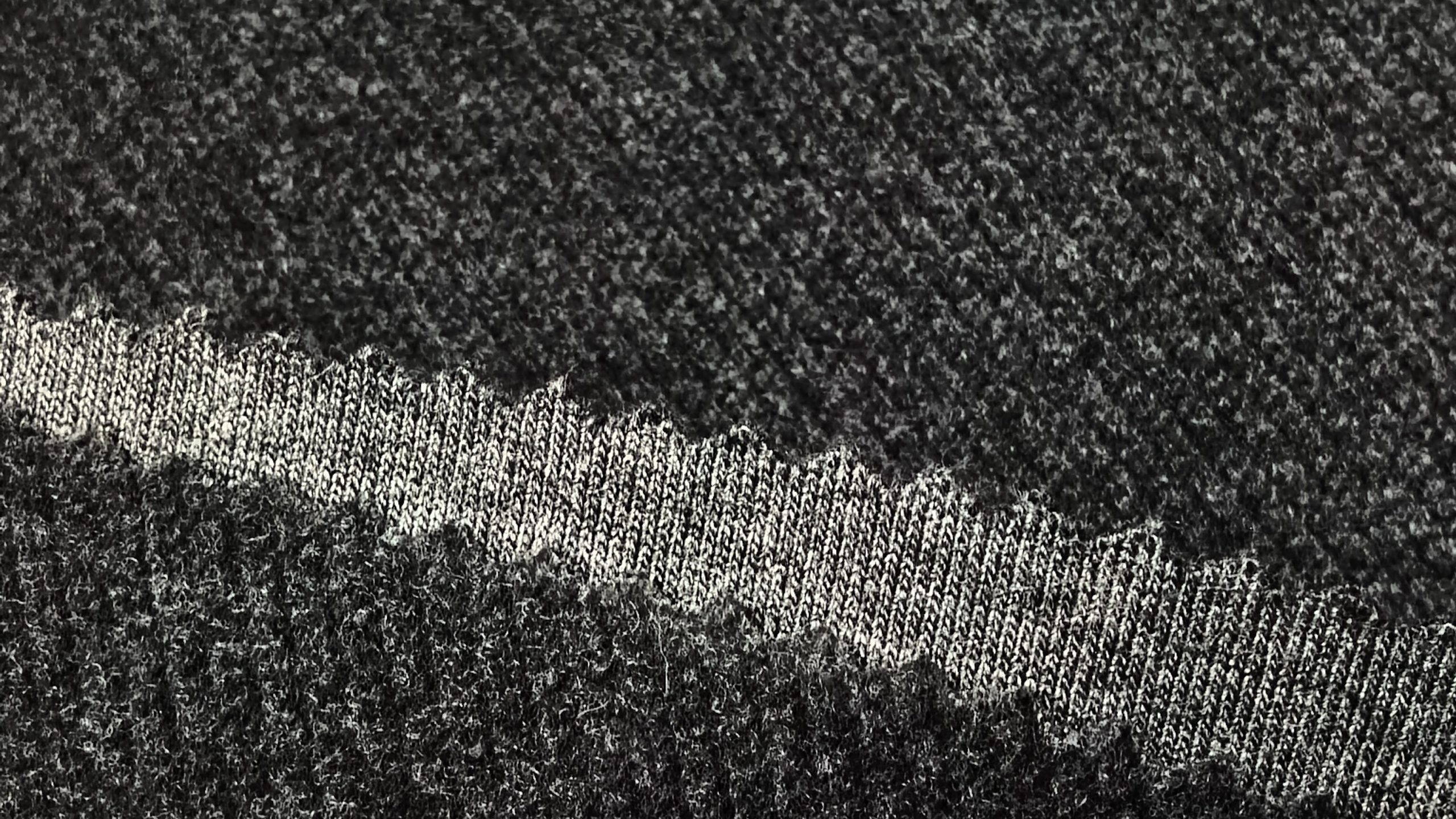
Bonded fabric is not a single material. It is a construction method in which two or more textile layers are fused together — typically a face fabric and a backing — using heat, adhesive or a combination of both. The result is a single, unified cloth that behaves differently from either layer on its own.
In wool-feel bonded fabric, the face layer is engineered to replicate the visual and tactile qualities of wool: melange yarn effects, twill structures, subtle sheen or textured surfaces. The backing layer is usually a jersey knit, fleece or cotton knit that provides softness against the skin, additional warmth and structural stability.
The key point for buyers: bonded fabric is not “fake wool.” It is a fabric system where the visible surface does one job (appearance, texture, aesthetic) and the hidden backing does another (comfort, warmth, stability). Both layers work together as a single material.
Why Garment Makers Are Adopting It for Winter Programmes
Traditional wool or wool-blend fabric has always required trade-offs. A heavy wool fabric looks appropriate for winter but can feel rough against the skin. A soft merino blend feels comfortable but may lack the structure needed for a tailored coat. A lined garment solves the comfort problem but adds cost, weight and manufacturing steps.
Bonded fabric addresses these trade-offs by combining the functions into one material.
Comfort Without a Separate Lining
The most immediate advantage is that the backing layer sits directly against the skin. For garments like unlined coats, trousers worn without tights, or jackets with minimal internal finishing, bonded fabric removes the need for a separate lining. This reduces sewing time, eliminates lining-related bulk at seams, and gives the garment a cleaner interior finish.
For manufacturers producing women’s trousers, tailored jackets or minimalist coat styles, this can simplify the construction process significantly.
Structural Stability in Heavier Weights
Wool-feel bonded fabrics in the 460–520 GSM range hold their shape well. The backing layer acts as a stabiliser, preventing the face fabric from stretching, distorting or losing its silhouette after wear. This matters for structured garments like overcoats, boxy jackets or wide-leg trousers where the fabric must maintain a clean line.
A single-layer wool fabric at the same weight may feel heavy and stiff. A bonded fabric at the same GSM can feel more flexible because the two layers share the mechanical load.
Surface Variety Without Sacrificing the Backing
Manufacturers can produce bonded fabrics with a wide range of face textures — herringbone, jacquard, melange twill, boucle, brushed surfaces — while keeping the backing consistent. This means a buyer can select different surface aesthetics for a collection (a herringbone coat, a jacquard jacket, a melange trouser) while maintaining the same handfeel and comfort profile across all styles.
For brands developing a cohesive autumn/winter range, this consistency simplifies sampling and reduces the risk of customer complaints about comfort variation.
Cost and Manufacturing Efficiency
Compared to pure wool or high-wool-content fabrics, bonded fabrics using polyester-viscose-wool blends offer a lower raw material cost while maintaining a wool-like appearance. The elimination of a separate lining step also reduces labour and sewing time.
For manufacturers producing at scale, these savings compound across a full winter programme.
What Buyers Should Evaluate Before Ordering
Selecting bonded fabric requires the same rigour as selecting any technical textile. The following evaluation points help buyers narrow the field before requesting samples.
1. GSM relative to the garment type. A 460 GSM bonded fabric suits structured trousers and mid-weight jackets. A 480–520 GSM fabric is more appropriate for heavy overcoats or garments that need to hold a firm silhouette. Buyers should match GSM to the garment’s intended weight class, not just select the highest available number.
2. Backing type and its effect on comfort. Jersey backing gives a smooth, cool-to-touch interior. Fleece backing adds warmth and a softer handfeel. Cotton jersey backing is useful for garments marketed to wearers with sensitive skin. The backing choice should align with the garment’s end-use and the brand’s comfort positioning.
3. Surface durability. Ask about pilling resistance and colour fastness. Bonded fabrics with polyester-rich face layers generally resist pilling better than high-wool blends, but this varies by manufacturer and yarn quality. Request a test swatch and evaluate it after repeated handling.
4. Sewing behaviour. Bonded fabric is thicker than single-layer fabric at the same GSM. Seams, hems and edge finishes may need adjustment. Buyers should provide the fabric to their pattern-maker or sample room before confirming bulk orders to check whether stitch density, needle size or seam allowances need modification.
5. Testing and certification requirements. If the target market requires specific testing (e.g. REACH compliance for European markets, flammability standards for certain garment categories), confirm with the supplier that the fabric can meet those requirements before placing the order. Testing should be agreed in advance, not assumed.
When Bonded Fabric Is Not the Right Choice
Bonded fabric is not a universal replacement for traditional wool. For garments where drape and fluidity are the primary requirements — soft, unstructured scarves, lightweight shawls or fluid draped styles — a single-layer lightweight wool or wool-silk blend may perform better. Bonded fabric is at its best in structured, medium-to-heavyweight garments where the backing adds functional value.
Buyers should also be aware that bonded fabric has limited stretch compared to knitted fabrics. If the garment design requires significant mechanical stretch, the bonded construction may not be suitable without additional elastane integration.
Summary
Wool-feel bonded fabric has become relevant for autumn and winter garment production because it solves real problems: comfort without lining, structural stability in heavy weights, surface variety with a consistent interior, and manufacturing cost savings. It is not a replacement for all wool fabrics, but for structured winter garments — coats, jackets, tailored trousers — it offers a practical alternative that simplifies production and improves wearer comfort.
For buyers evaluating bonded fabric for an upcoming programme, the selection process starts with the garment type, moves to GSM and backing selection, and finishes with sample evaluation before bulk commitment.
Huajay’s current wool-feel bonded fabric collection is listed at huajay.net/products, organised by series (herringbone, jacquard, tweed-boucle, melange twill) with specifications and application guidance for each style.