
For garment buyers and brands developing winter collections, “itchy fabric” is one of the most common wearer complaints — and one of the most misunderstood. Many people assume that itch is an allergic reaction to wool. In reality, the discomfort is almost entirely mechanical: it comes from how the fibre interacts with the skin’s surface, not from an immune response.
Understanding the actual cause of itch changes how buyers evaluate fabric for winter garments. It also explains why wool-feel bonded fabric — with its two-layer construction — solves the problem more effectively than chemical treatments or layering tricks.
The Real Cause of Wool Itch: Fibre Diameter and Cuticle Structure
Wool itch is caused by two physical properties of the fibre, both of which create mechanical friction against the skin.
Fibre diameter. Coarser fibres (typically above 30 microns in diameter) are stiff enough that they do not bend when they press against the skin. Instead of flexing, they push into the epidermis, triggering the nerve endings that register as prickling or itching. Fine fibres (below 20 micons, like merino) bend on contact and do not trigger the same response.
Most conventional wool used in mass-market winter garments falls in the 25–35 micron range — coarse enough to cause discomfort for wearers with sensitive skin, but fine enough to be marketed as “soft wool.”
Cuticle scales. Wool fibres have a scaly outer surface, similar to a pine cone viewed under magnification. These cuticle scales create micro-friction as they rub against the skin. The combination of stiff fibre + rough surface is what produces the persistent, low-grade irritation that wearers describe as “itchy.”
This is not an allergy. It is a mechanical friction problem — and it can be solved structurally, not chemically.
Why Home Remedies Fall Short
A quick search for “how to stop wool from itching” returns a familiar list of home remedies. None of them address the root cause.
Vinegar or hair conditioner soaks. These temporarily smooth the cuticle scales and soften the fibre. The effect lasts through a few wears before the scales roughen again and the stiffness returns. Repeated chemical treatment can also degrade the fibre’s natural resilience, leading to pilling and loss of shape.
Wearing a base layer underneath. A silk or cotton undershirt creates a physical barrier between the wool and the skin. This works — but it changes the garment’s fit, adds a layer of bulk, and leaves areas like the neck and cuffs exposed to direct contact with the coarse fibre.
Both approaches manage the symptom. Neither changes the fundamental problem: the outer surface of the fabric is too coarse for comfortable direct skin contact.
How Bonded Fabric Solves It Structurally
Wool-feel bonded fabric addresses the itch problem at the construction level. Instead of treating the fibre or adding a separate garment layer, the solution is built into the fabric itself.
The construction works like this:
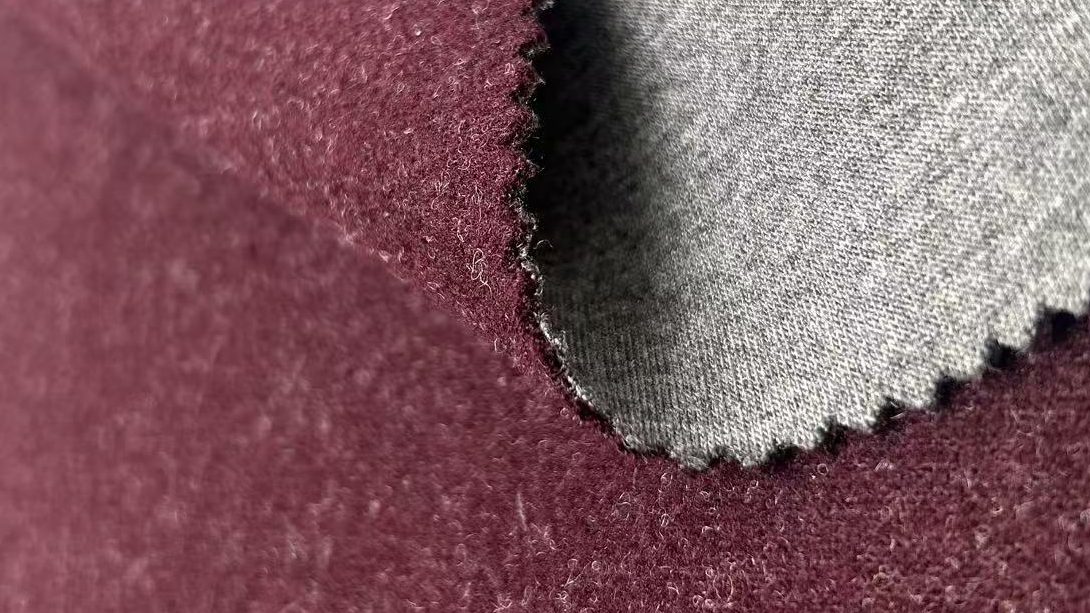
- Face layer: The visible side of the fabric is engineered to look and feel like wool — with melange yarn effects, twill textures, or other surface qualities that give winter garments their expected aesthetic.
- Backing layer: The side that touches the skin is a soft jersey knit, fleece, or cotton knit. This layer has a smooth, uniform surface with no coarse fibres or cuticle scales.
Because the backing is what contacts the skin, the itch mechanism never activates. The coarse, scaly face layer is on the outside where it is visible and protected. The smooth, soft backing is on the inside where it touches the wearer.
For garments worn directly against the skin — trousers, unlined jackets, coats with minimal interior finishing — this construction eliminates the itch problem without any chemical treatment or additional layering.
A Comparison of Solutions
| Approach | Duration | Effect on Fit | Skin Coverage | Maintenance |
|---|---|---|---|---|
| Vinegar/conditioner soak | Temporary, fades after a few wears | Can degrade fibre over time | Incomplete, treatment is uneven | Hand-wash required |
| Base layer underneath | As long as the layer is worn | Adds bulk, changes drape | Gaps at neck, cuffs, openings | Extra garment to launder |
| Bonded fabric construction | Permanent, built into the fabric | No change, clean interior seams | Complete, backing covers entire inner surface | Standard care, no special handling |
What This Means for Garment Buyers
For brands and manufacturers, the bonded fabric solution has practical implications beyond wearer comfort.
Fewer customer complaints. Itch is one of the top reasons winter garments are returned or receive negative reviews. Using bonded fabric with a soft backing removes this risk at the material selection stage, before the garment is even sewn.
Wider market reach. Many consumers avoid wool garments entirely because of past discomfort. A bonded fabric that looks like wool on the outside but feels soft against the skin allows brands to market to this segment — buyers who want the aesthetic of winter fabric without the irritation.
Simpler garment construction. Without the need for a separate lining, the garment has fewer internal seams, less bulk at edges, and a cleaner finish. This reduces sewing time and gives the final product a more refined interior appearance.
Consistent comfort across a collection. By selecting the same backing type across multiple face fabrics, brands can ensure that every garment in a winter collection — a herringbone coat, a jacquard jacket, a melange trouser — delivers the same comfort profile.
Selecting the Right Backing for the Garment
Not all backings perform the same way. Buyers should match the backing to the garment’s intended use and target wearer.
- Jersey backing gives a smooth, lightweight interior. Suitable for trousers, jackets and garments where a cool-to-touch feel is preferred.
- Fleece backing adds warmth and a plush handfeel. Better for heavy overcoats or garments intended for very cold conditions.
- Cotton jersey backing is the most skin-friendly option. Recommended for garments marketed to wearers with sensitive skin, or for styles worn directly against the body without an undershirt.
When requesting samples, buyers should specify the backing preference alongside the face fabric selection. Most suppliers can provide the same face texture with different backing options for comparison.
Summary
Wool itch is a mechanical friction problem caused by coarse fibre diameter and scaly cuticle surfaces — not an allergy. Home remedies treat the symptom temporarily; bonded fabric treats the cause permanently by placing a smooth, soft backing layer between the coarse face fibre and the wearer’s skin.
For garment manufacturers developing winter collections, bonded fabric offers a material-level solution that eliminates itch complaints, simplifies construction, and opens the wool-aesthetic market to consumers who previously avoided it.
Huajay’s wool-feel bonded fabric range uses jersey and fleece backing options across all listed styles. Specifications and backing details are available at huajay.net/products. For sample requests with specific backing preferences, use the contact form.